How to Get More Dental Patients: Building a Predictable New-Patient Acquisition System
For many dental practices, new-patient growth feels inconsistent. One month brings a steady flow of calls and appointment requests. The next is noticeably slower, with no clear explanation for the change.
Referrals, Google searches, online reviews, paid advertising, social media, and community visibility may all contribute to growth. But when these efforts operate separately, it can be difficult to understand what is working, where prospective patients are being lost, and what the practice should improve next.
Sustainable growth requires more than doing additional marketing. It requires a new-patient acquisition system: a connected process that helps the right people discover your practice, understand its value, trust your team, and schedule an appointment.
This guide explains the essential parts of that system and provides a practical framework for identifying the gaps that may be limiting your growth.
What Is a New-Patient Acquisition System?
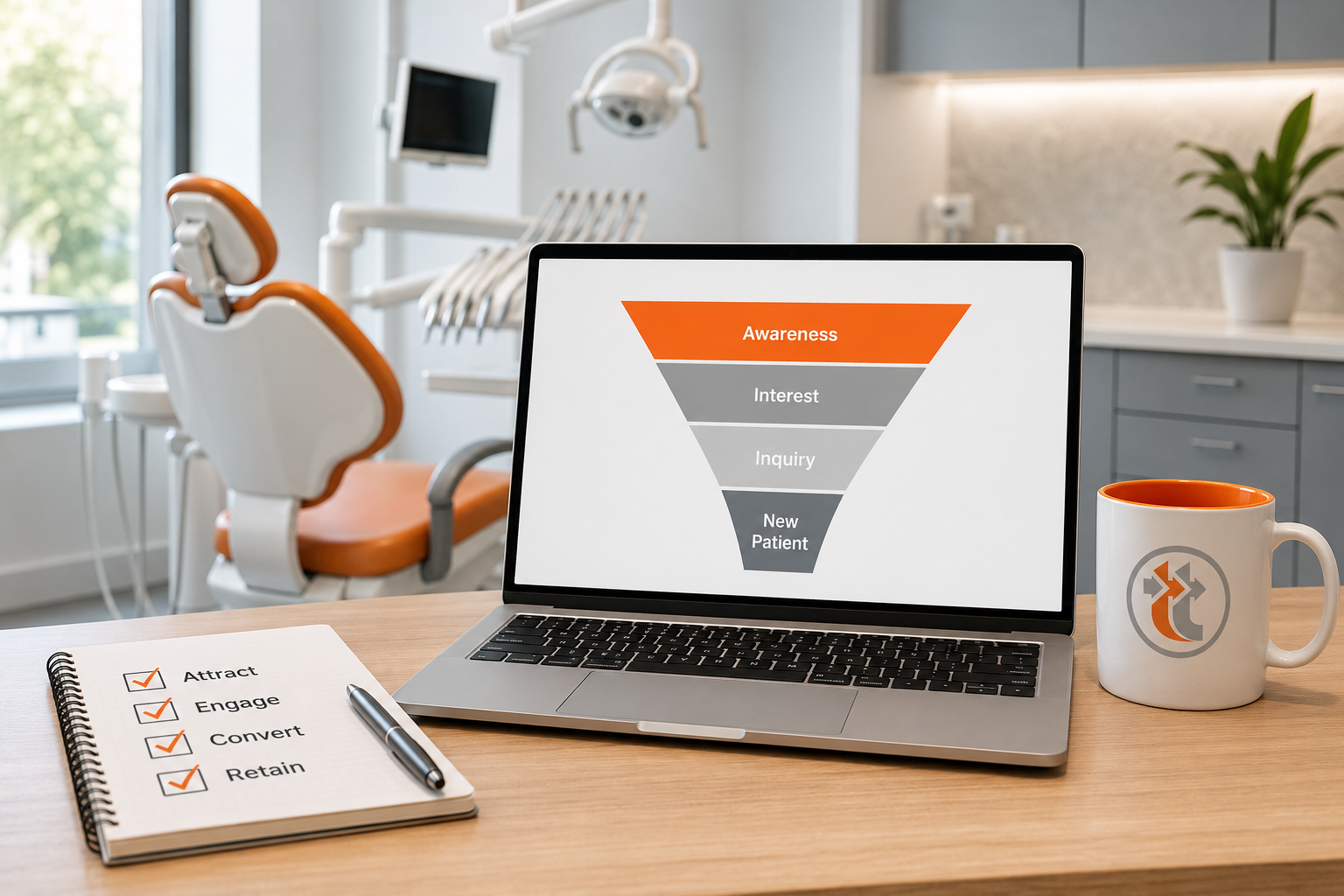
A new-patient acquisition system is the complete journey that moves someone from recognizing a dental need to becoming a patient.
That journey generally includes six stages:
- Awareness: The prospective patient discovers your practice.
- Interest: They recognize that your services may address their needs.
- Evaluation: They review your providers, website, reputation, services, and patient experience.
- Inquiry: They call, submit a form, send a message, or request an appointment.
- Conversion: Your team turns the inquiry into a scheduled visit.
- Retention: The patient returns for future care and may recommend the practice to others.
Many dental marketing efforts focus heavily on awareness by generating website visits, ad clicks, social media reach, or video views. Those activities may be useful, but they represent only the beginning of the patient journey.
A predictable system considers what happens at every stage.
1. Identify the Patients and Services You Want to Grow
“More patients” is not always a clear enough marketing objective. Before investing in advertising, content, or search visibility, define the type of growth your practice needs. Your priorities might include:
- New hygiene patients
- Families looking for a long-term dental home
- Dental implant consultations
- Cosmetic dentistry cases
- Emergency appointments
- Invisalign or clear aligner patients
- Patients needing crowns, bridges, or dentures
Each audience has different concerns and decision-making timelines. Someone searching for an emergency dentist may choose a provider quickly. A patient considering implants may spend weeks comparing treatment options, providers, financing, reviews, and expected outcomes.
For each priority service, answer four questions:
- Who is the ideal patient?
- What problem are they trying to solve?
- What could prevent them from scheduling?
- What information would help them feel comfortable choosing your practice?
These answers should guide your messaging, website content, advertising, educational materials, and follow-up process.
2. Build Visibility Where Patients Are Already Looking
When people need dental care, many begin with a local search. They may look for a general dentist, a specific procedure, or a provider near their home or workplace.
Your practice needs to be visible during those high-intent moments.
Strengthen your Google presence
Your Google Business Profile should be accurate, complete, and current. Important information includes:
- Practice name, address, and phone number
- Office hours
- Appointment links
- Services
- Provider and office photos
- Patient reviews
Your Google Business Profile may be one of the first places prospective patients see your location, hours, services, photos, and reputation.
Create useful pages for priority services
Dedicated pages for your most important services can provide patients with more useful information while giving search engines clearer context about the treatments your practice offers.
A strong service page should explain:
- The problem or need
- The treatment
- Who may be a candidate
- What patients can expect
- Why they should consider your practice
- How to take the next step
The goal is not to create unnecessary pages for every possible service. Focus first on treatments that are most important to your patients and your growth objectives.
Keep local information consistent
Your practice name, address, phone number, website, and provider information should remain consistent across relevant directories and platforms. Conflicting or outdated information can create confusion and weaken confidence in the practice.
3. Use Paid Advertising Strategically
Search engine optimization (SEO) can create valuable long-term visibility, but it often takes time. Paid advertising can help your practice reach prospective patients more quickly.
Google Ads and social media advertising play different roles.
Google Ads captures active demand
Google Ads can reach people who are already searching for services such as:
- Emergency dentist
- Dentist accepting new patients
- Dental implants
- Cosmetic dentist
- Invisalign provider
- Family dentist near me
These searches often indicate immediate or developing interest.
However, successful dental advertising requires more than choosing keywords. Geographic targeting, ad messaging, landing pages, call handling, appointment availability, and performance tracking all influence the outcome.
Social advertising builds awareness and supports consideration
Social platforms like Meta can introduce your practice to people who may need care but are not actively searching yet.
For example, an educational video about missing teeth, chewing difficulties, or alternatives to dentures may help someone recognize that implant treatment is worth exploring.
Social advertising may be useful for promoting:
- Dental implants
- Cosmetic dentistry
- Clear aligners
- Smile transformations
- Educational provider videos
- Patient stories and testimonials
- New-patient offers
Educational videos, credible patient stories, and consistent provider content can help prospective patients become more familiar with the practice and feel better informed about their options.
Used together, search and social advertising can help capture existing demand while supporting future demand.
4. Build Trust Before Asking Patients to Schedule
Prospective patients are not evaluating only your clinical services. They are also evaluating whether your practice appears credible, professional, comfortable, and organized.
Before contacting you, they may review:
- Google ratings and recent reviews
- Provider biographies
- Office photos
- Website content
- Social media activity
- Patient testimonials
- Before-and-after examples
- Insurance and payment information
- Explanations of treatments
Helpful trust-building content may include:
- Videos introducing the dentist and team
- Answers to frequently asked questions
- Clear explanations of procedures
- Content addressing dental anxiety
- Patient testimonials
- Information about financing and payment options
The objective is not to overwhelm patients with information. It is to address the questions and concerns that might otherwise prevent them from taking the next step.
Before publishing patient testimonials, photographs, videos, treatment stories, or before-and-after content, confirm that the practice has obtained any required authorizations and that the material follows applicable privacy laws, professional regulations, advertising requirements, and platform policies.
5. Make Your Website Easy to Understand and Use
A dental website should do more than look professional. It should help prospective patients decide whether the practice is right for them and make it easy to take action.
Within a few seconds, visitors should understand:
- Who you serve
- What services you provide
- Where you are located
- Why they should trust you
- How to request an appointment
Common website conversion problems include:
- Unclear messaging
- Difficult mobile navigation
- Generic treatment descriptions
- Slow loading
- Too many competing calls to action
- Long or complicated forms
- Important information buried within the site
- No clear differentiation from nearby practices
Each important page should guide visitors toward one logical action, such as calling the office, requesting an appointment, or scheduling a consultation. A strong website does not pressure patients. It reduces uncertainty and makes the next step easier.
6. Improve the Journey From Inquiry to Appointment
Lead generation does not end when someone calls or submits a form.
Prospective patients can still be lost because of:
- Missed calls
- Delayed responses
- Inconsistent follow-up
- Confusing insurance explanations
- Limited scheduling options
- Unclear consultation steps
- No process for patients who are not ready immediately
Review how your practice handles each inquiry.
Ask:
- How quickly do we respond?
- Who is responsible for follow-up?
- Are calls and forms tracked by source?
- Do we know why prospective patients do not schedule?
- Are high-value treatment inquiries followed up consistently?
- Can the team explain priority services clearly and confidently?
A CRM or organized lead-tracking process can help prevent inquiries from disappearing into email inboxes, handwritten notes, or disconnected systems.
Improving response time and follow-up can help your practice convert more of the inquiries it already receives, although results will also depend on lead quality, scheduling availability, pricing, and the overall intake experience.
7. Measure Patient Growth, Not Just Marketing Activity
Impressions, clicks, followers, and website visits can provide useful information, but they do not tell the complete story.
Dental practices should also track outcomes such as:
- Qualified calls and form submissions
- Appointment requests
- Scheduled appointments
- Appointment show rates
- Lead-to-appointment conversion rates
- Cost per qualified opportunity
- Cost per scheduled patient
- Lead sources
- Treatment interest
- Case acceptance
Patients may interact with your practice several times before scheduling. Someone might watch a video, later search for your practice, read reviews, visit the website, and finally call.
Perfect attribution is difficult. The goal is to develop enough visibility to make better decisions.
Your reporting should help answer three practical questions:
- Which activities are producing qualified patient opportunities?
- Where are prospective patients dropping out of the process?
- What should the practice improve next?
A Practical New-Patient System Audit
Use these questions to evaluate your current system.
Strategy
- Have we identified the services and patient groups we want to grow?
- Is our marketing aligned with our capacity and business goals?
Visibility
- Can prospective patients easily find us on Google?
- Do priority services have useful website pages?
- Is our practice information accurate across platforms?
Trust
- Do our website, reviews, photos, and videos communicate credibility?
- Are we answering the questions patients commonly ask before scheduling?
Conversion
- Is it easy to call or request an appointment from a mobile device?
- Does every important page provide a clear next step?
- Does our team respond quickly and follow up consistently?
Measurement
- Do we know where inquiries come from?
- Can we connect marketing activity to scheduled appointments?
- Are we evaluating lead quality rather than lead volume alone?
The weakest stage often limits the performance of the entire system. More traffic will not solve an unclear website. More leads will not solve poor follow-up. Better content will not solve weak local visibility.
Creating More Predictable Dental Practice Growth
Learning how to get more dental patients is not about finding one perfect campaign, platform, or marketing tactic. It is about creating a connected system in which each component supports the next:
 Visibility creates awareness.
Content supports trust.
The website encourages action.
The team converts inquiries.
Tracking reveals what to improve.
Start by identifying the largest gap in your current patient journey. Strengthen that area, measure the result, and continue improving the system over time.
Right Tactic helps dental practices connect these pieces into a coordinated new-patient acquisition strategy. A strategic review can provide an outside perspective on where opportunities may be getting lost and which improvements deserve priority.
Ready to identify the gaps in your new-patient system? Start a conversation with Right Tactic.
Tags:
New-Patient Acquisition System For Dentists and Orthodontists
Dentist Marketing
Video Marketing
Content Marketing
Website Design and Development
Social Media Marketing
Marketing Strategy
Digital Advertising and PPC
Search Engine Optimization (SEO)
Patient Lead Generation
Digital Marketing
Right Tactic News
Patient Acquisition Marketing
Medical Practice Marketing
Best Dental Marketing Agency
Fishers Dental Marketing
Lawrence Dental Marketing
Westfield Dental Marketing
Carmel Dental Marketing
Dental SEO
Dental Websites
Digital Advertising Management
Dental Marketing Experts
Related Blogs
- Browse Topics
- All
- Right Tactic News
- Dentist Marketing
- Orthodontist Marketing
- Medical Practice Marketing
- Patient Lead Generation
- Digital Marketing
- Marketing Strategy
- Digital Advertising and PPC
- Social Media Marketing
- Website Design and Development
- Search Engine Optimization (SEO)
- Generative Engine Optimization (GEO)
- Content Marketing
- Video Marketing